
3.6 KiB
Phonograph
Phonograph is a friendly, collaborative data platform for nerds of all stripes, built around PostgreSQL.
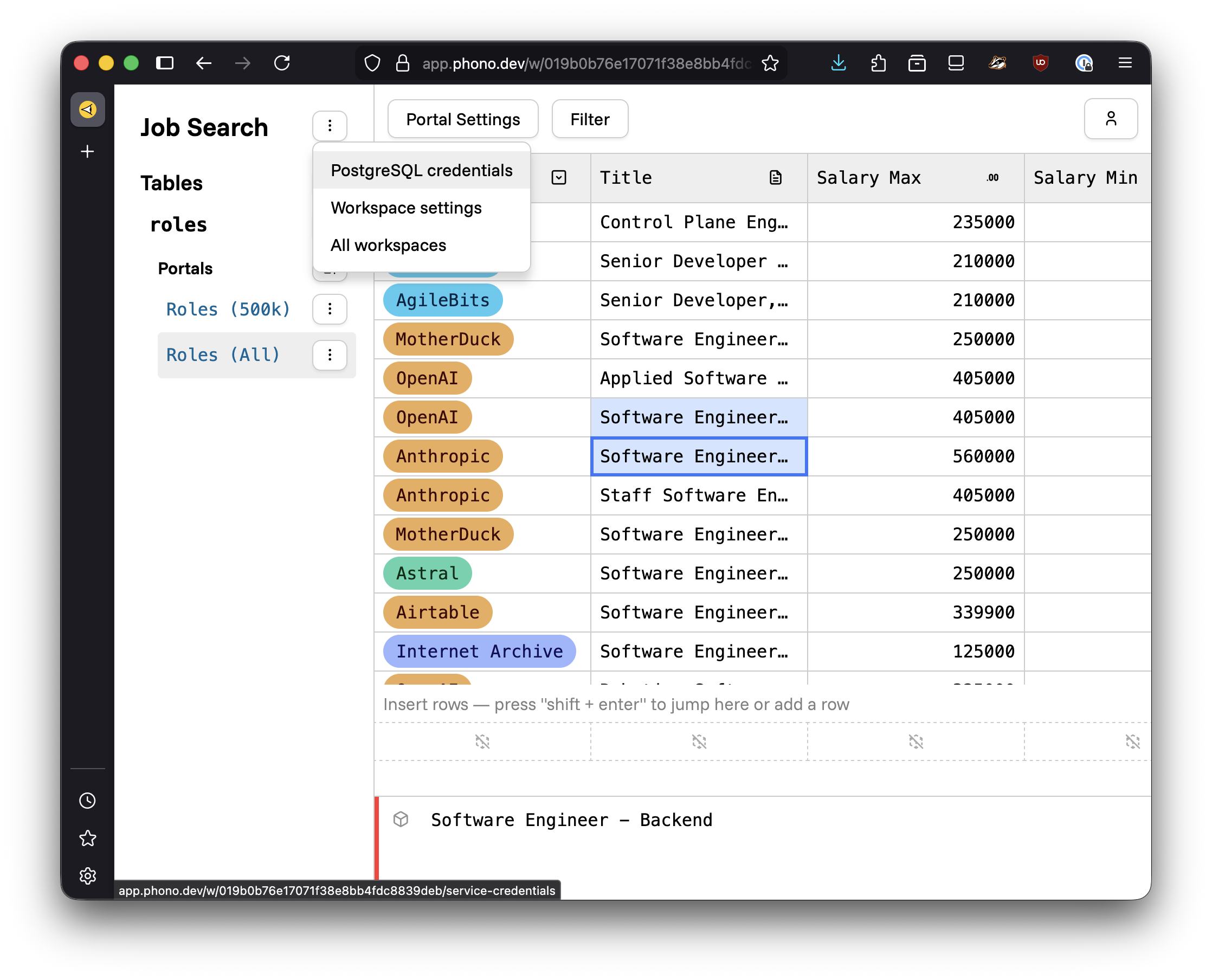
Contemporary browser-centric platforms like Airtable open new frontiers for data engineering, but they suffer from limitations that conventional databases have long since addressed: relational data models are an afterthought; row-level security is missing; third party integrations must be implemented piecemeal for lack of a standardized API. Phonograph addresses these shortfalls by implementing an accessible front-end interface backed by an existing, mature database management system.
Browser Compatibility Note
CSS anchor positioning is a relatively new API, and Phonograph uses it extensively. Browser support is now fairly good, but Firefox users in particular should upgrade to version 147 or newer for best experience.
Development Quickstart
The Phonograph repository comes with a mise-en-place configuration to automatically manage the development environment:
mise installinstalls language runtimes and tooling.mise run build-css && mise run build-sveltebuilds browser assets.mise run docker-servicesruns a Postgres container for local development.mise run servercompiles and runs the server with the dev profile.
Configuration
Refer to the .env.example file for configuration options. An external OAuth2 provider is required to manage authentication.
The Phonograph Authorization Model
Refer to documentation in docs/auth.md.
Copyright and License
All original source code in this repository is copyright (C) 2025 Second System Technologies LLC and distributed under the terms in the "LICENSE" file. Certain third-party assets within the "static" directory may be governed by different licenses, for example the Open Font License or MIT License, as stated by their original authors. Copies of each relevant license have been included alongside these files as needed.
LLM Code Policy
Large language model code generation is permitted sparingly in very limited cases, for example for completing clearly defined transformations which span multiple files and are not supported by conventional code actions. All code generated by LLMs is considered reflective of its author, and authors are expected to thoroughly and frequently review before committing affected work.
As of this writing, models display a strong bias towards patterns which are well represented in public open source projects. This can cause them to tend towards suboptimal one-size-fits-most or simply outdated coding practices in certain circumstances. LLM assistance should be sufficiently constrained to avoid allowing outputs to dictate or implicitly guide significant design decisions.
Furthermore, current language models broadly behave adversarily, in the sense that they are optimized to make perceiving model outputs versus non-model outputs as difficult as possible. This can make generated code uniquely challenging to review effectively. In this context, non-trivial business logic, particularly logic with security implications, may not be implemented with direct assistance from LLM tools.
Examples of LLM-assisted changes in practice:
- Replacing SVG icons with similar webfont icons from a different icon pack.
(Revision
ztrnxzqv(Gita8dd49f7))